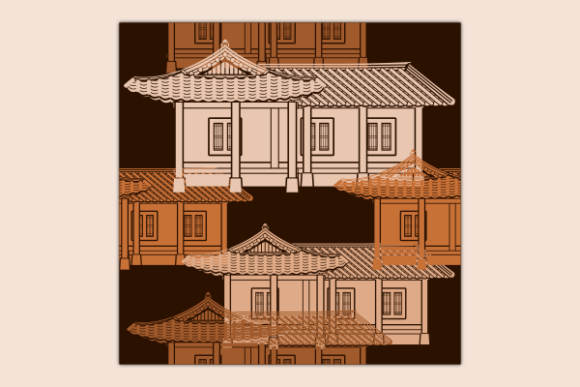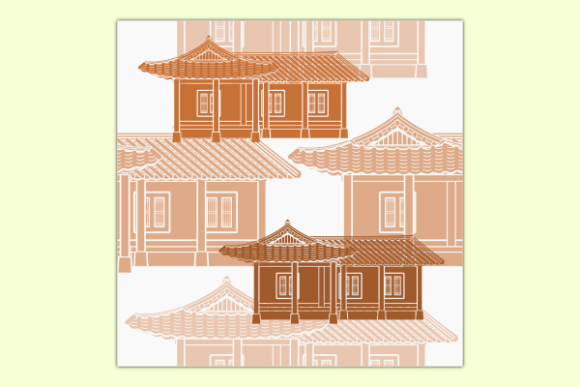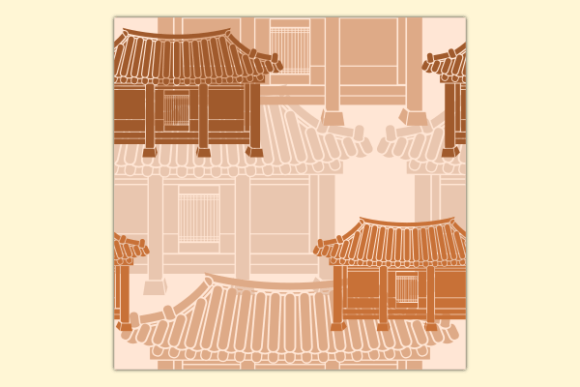
Front View Korean House Seamless Pattern
When I first opened the file, the clean, flat monochrome lines of the traditional hanok houses immediately felt like something I’d want to stitch onto a natural linen tote and carry straight to a slow Sunday market. There’s a quiet confidence in the way the rooftops repeat without shouting, and that kind of graphic restraint is exactly what I look for when I’m planning a new line of handmade products for my small Etsy shop. The Front View Korean House Seamless Pattern isn’t trying to be flashy; it’s a humble, beautifully structured motif that whispers cultural richness rather than yelling it. Right away, I could picture it on a tea towel in a kitchen that smells like jujube tea, or peeking out from the corner of a baby’s crib quilt. But as every embroidery designer knows, a pretty screen image doesn’t always translate to a clean stitch-out. So I sat down with my digitizing software, a cup of barley tea, and a healthy dose of practical skepticism to figure out where this pattern could genuinely earn its place in a real embroidery project.
A Quiet Pattern That Tells a Cultural Story
The repeat is built from front-facing hanok illustrations—those iconic gently curved tile roofs, simple wooden pillars, and understated rectangular foundations. The flat monochrome style means no shading, no gradients, just pure silhouette and linework. That’s a gift for embroidery because it eliminates the guesswork of translating complex tonal values into stitch angles. The seamless layout flows like a calm wallpaper, which is perfect for fabric printing, but for machine embroidery, it asks a more thoughtful question: do you try to stitch the full repeat, or do you pull a single motif out of the pattern and let it stand alone? In my experience, going for a full repeat across a large area usually ends up with a stiff, overly dense panel that feels more like armor than fabric. So I immediately started seeing this pattern as a library of individual hanok elements, not just one massive repeating tile.
From Screen to Stitch: The Reality of Digitizing Vector Art
The fact that this is delivered as an editable SVG vector is a huge plus for embroidery designers who like to tweak shapes before digitizing. You can open it in your vector software, isolate just one house, scale it to fit your hoop, and simplify any tiny details that might close up under thread. Because the artwork is monochrome, it naturally lends itself to a clean running stitch or a crisp satin stitch outline, and you can even experiment with a light fill stitch for the roof tiles if you want a bit more texture. But here’s the thing: a seamless pattern is designed for continuous repeat, not for the stop-and-start nature of embroidery. If you try to digitize a 12-inch square of this pattern as a single embroidery file, you’re looking at a stitch count that will make your machine groan and your fabric pucker. The smarter move is to treat each hanok as a standalone embroidered patch or a strategic accent on a larger surface. I’ve learned that lesson the hard way on a sweatshirt project where I used a repeating floral background—it looked beautiful on screen but turned into a bulletproof vest after stitching. So I’d advise anyone eyeing this pattern for embroidery to think in terms of single motifs, spaced repeats, or border designs rather than all-over fills.
Where This Design Actually Shines on Handmade Products
After working with the file for a few hours, I started mentally placing it on some of the products I sell regularly. The understated architectural shape feels incredibly natural on home décor items. A single hanok motif, digitized at about 4 inches wide, would sit beautifully on the corner of a linen pillow cover, or lined up in a row of three across the front of a canvas apron. For a tote bag design, I’d use two houses facing each other with a little space between them—it creates a welcoming, gate-like feel that customers tend to love on market totes. The pattern also has a quiet, heritage-inspired mood that works wonderfully for baby gifts and nursery décor. A soft cotton baby blanket with a single hanok embroidered in a matte taupe thread on cream fabric feels both modern and deeply rooted, the kind of personalized gift that gets passed down. And because the design is monochrome, it doesn’t compete with other colors in the room, which makes it a safe choice for custom apparel like a neutral-toned sweatshirt or a minimalist cap.
The Tote Bag Test: A Real Client Project
Last week, I actually used a motif from this pattern for a custom order—a bride wanted a set of thank-you gifts for her wedding party, and she requested something with a Korean traditional touch. I pulled a single hanok from the vector file, cleaned up the roofline slightly (the original had a tiny decorative element that would have been lost at 3 inches), and digitized it as a simple two-color satin stitch outline with a subtle fill stitch on the roof. The thread was a warm charcoal on a natural-colored cotton tote, and the result was understated but unmistakably elegant. The bride’s mother cried. That’s the kind of reaction that tells me a design has real emotional pull. When I posted the finished tote on my shop’s Instagram, I got a dozen messages asking if I’d make more. That’s the power of a culturally specific, thoughtfully drawn motif—it stands out in a sea of generic floral and script designs.
Things to Watch Out for Before You Stitch
No design is perfect for every situation, and the Front View Korean House Seamless Pattern has a few practical considerations that any maker should think through before committing to a project. The flat, repetitive nature means that if you do try to use it as a true all-over pattern on a garment, you’ll need to be very careful about stitch density and fabric choice. A stretchy knit will distort under heavy embroidery, and a thin fabric will show every thread on the back unless you use a high-quality stabilizer. I’d also avoid using this pattern on very dark fabrics unless you’re prepared to test thread colors extensively—a black thread on dark denim might disappear, while a white thread could look too stark. The key is to test on a scrap of the exact fabric you plan to use, and to check the design in a black-and-white preview to see how the contrast holds up. Small details like the roof eaves and pillar bases can close up if your hoop size forces the design to be too small, so I’d recommend a minimum stitch-out width of 2.5 inches for any single motif from this pattern.
Stabilizer and Thread Choices That Make or Break the Look
For a structured fabric like a cotton tote or a linen tea towel, a medium-weight cutaway stabilizer is your best friend—it keeps the lines crisp and prevents shifting during the stitch-out. On a stretchy sweatshirt, I’d use a fusible mesh stabilizer and float a piece of tear-away underneath for extra support. The monochrome nature of the original artwork gives you a lot of freedom with thread color, but I’d steer clear of highly variegated threads unless you’re going for a playful, crafty look. A solid matte polyester thread, like a deep navy or a warm clay tone, plays up the traditional vibe and stitches out beautifully. If you’re using this pattern for a baby embroidery project, softer pastel threads on white or cream fabric create a gentle, heirloom feel. Just remember that a single-color design relies entirely on shape and stitch quality to hold visual interest, so every uneven stitch will show. Take the time to get your tension perfect.
Is This Pattern Right for Your Craft Business?
As a digital embroidery file resource, this pattern is more of a starting point than a ready-to-stitch file. You’ll need to digitize it yourself or hire a digitizer, and you’ll need to confirm the licensing terms of the original SVG before you sell finished items or include the design in a commercial embroidery collection. The product description mentions it’s editable and can be used for fabric backgrounds, which suggests it’s intended for print-on-demand and surface design, but many digital product sellers also allow embroidery use. Always check before you list a small shop product that uses someone else’s artwork. For Etsy sellers and handmade business owners who do their own digitizing, this pattern offers a lot of creative flexibility. You can use it as a base for applique design by separating the roof and wall sections into different fabric pieces, or you can turn it into a clean embroidered patch by adding a border. The pattern’s flat style also makes it a great candidate for printable mockups—you can use the vector to create lifestyle images for your listings without having to photograph every color variation.
Final Thoughts from an Embroidery Designer’s Worktable
I’ve tested a lot of vector patterns in my embroidery workflow, and many of them fall apart at the stitch level because they were never drawn with thread in mind. The Front View Korean House Seamless Pattern is one of the rare ones that actually translates better than I expected—not because it’s embroidery-ready, but because its visual DNA is so honest and simple that it doesn’t need to be complicated to feel special. For a maker who understands the difference between a printed repeat and a stitched motif, and who is willing to do a little editing in their digitizing software, this pattern can become the quiet backbone of a beautiful, culturally inspired product line. I’d personally use it on a series of kitchen towels, a set of unisex linen aprons, and maybe a small run of baby blankets for a holiday collection. But I’d also do a full test stitch on a scrap of the exact fabric I plan to use, with the exact thread and stabilizer, before I ever promised a finished product to a customer. That’s not a criticism of the design—it’s just good embroidery practice. If you’re the kind of maker who loves turning a flat vector into a tangible, textured piece of art, this pattern is worth a quiet afternoon of experimentation. Just let your needle do the talking.